Everyday places / 2026-11-12 / 6 minutes to read
A place to pause
What an ordinary bench can tell us about a city that knows how to wait.
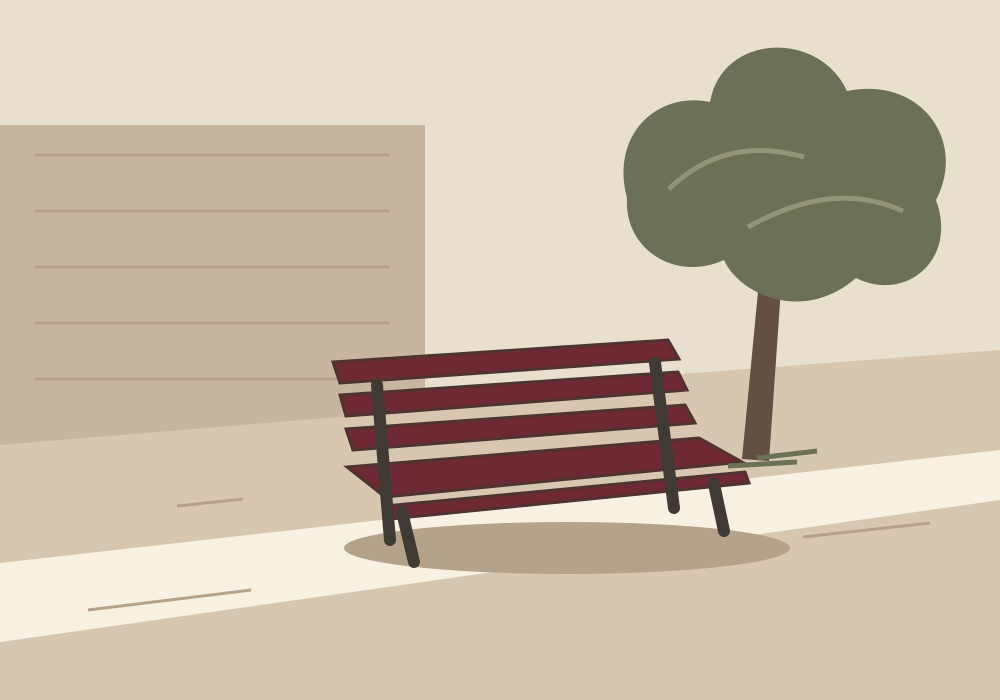
A place to pause · original illustration, not a documentary photograph.
At the edge of a square stands a bench. It offers no remarkable view: a wall ahead, a path to one side, a small tree behind. Yet it is a place where someone might want to stay. Not because it promises an experience, but because it asks for nothing in return.
This imagined observation is not about a particular square. It is a way of looking at a city from the height of a seated person. On a plan, a small paved area may appear to be empty space. To someone carrying a heavy bag or waiting for a friend, it can be the most useful part of a journey. Convenience rarely looks like an event.
Imagine spending a quarter of an hour here. Someone adjusts a shoelace. Someone finishes a conversation. Another person simply looks ahead. These activities have no shared outcome to put in a report. What they share is permission to stop moving for a while.
A place to pause begins with ordinary details. The seat stays dry after light rain. A backrest offers support, with room beside it for a wheelchair or a pushchair. The path does not end in an unexpected step. Shade reaches the place where a person actually sits, rather than the place where it looks attractive on a drawing. None of these details can do the work of all the others.
Discussions of comfort easily become arguments about taste. One person prefers timber, another metal; one wants quiet, another wants to be near a busy street. It helps to ask first what actions a place allows. Can you sit without buying a drink? Can you stand up without help? Can you wait beside a companion who finds walking difficult? These questions do not produce a universal design, but they make differences visible.
Time is another, less obvious consideration. A bench unused in the morning may be needed in the evening. Low winter sunlight changes where people choose to sit. When a nearby passage is closed for repairs, the same paved space becomes part of a different route. One brief visit is not enough to declare it unnecessary.
Observation also needs to be separated from guesswork. If someone gets up quickly and leaves, we do not know whether the seat was uncomfortable. If the place is empty, we do not know whether it is waiting for another hour. A notebook can hold two lines: what we saw, and what we assumed. The gap between them keeps a small observation from becoming an overconfident conclusion.
This is not an invitation to turn every walk into a research project. It is an invitation to notice the infrastructure that tends to disappear from attention when it works well. A bench does not have to become a landmark. Its purpose is more modest: to let a person remain in the city a little longer, without explaining why.
Next time, take a familiar route more slowly. Find one place where stopping feels easy, and another where stopping is impossible. Remember the difference. Sometimes a conversation about a large city becomes more precise through a comparison this small.
Between Lines · Issue 01 · 2026